Which type of boiler do I have?
This guide will help identify your current boiler and explain the differences between the other types available, along with the main advantages, and disadvantages of each.
Regular Boiler
If you have a large tank of cold water in the attic and a hot water cylinder in an airing cupboard, you have a regular boiler, also known as a traditional or conventional boiler.
Here are some advantages to keep in mind when comparing regular boilers to other types:
Advantages of regular boilers
-
Large hot water storage capacity:
Suitable for larger homes and those with a high demand for heating and hot water. -
Save money:
Newer condensing boilers can be up to 97% efficient, reducing your energy bills. -
Immersion heater:
This can be fitted so that you have backup hot water ready. -
Environmentally-friendly options:
Many regular boilers can be used in conjunction with solar panels.
Disadvantages of regular boilers
-
Requires more room and has a limited supply:
You’ll have to make space for a hot water storage tank in the loft or airing cupboard, which if the water runs out, you’ll have to wait for the water to refill and reheat.
However, with this being said, it’s advised to only install a regular boiler when it’s a like-for-like replacement otherwise the installation costs can be very expensive. This is because they usually require complex pipe work which is time-consuming.
A system boiler is likely a better alternative if you’re in need of a boiler with a large hot water storage capacity.
Combination Boiler
If you only have a boiler in your home (no cylinder or tank) and the boiler produces hot water on demand, you have a combi boiler.
Here are some advantages to keep in mind when comparing combi boilers to other types:
Advantages of combi boilers
-
Compact:
Combi boilers’ all-in-one units mean they can be installed easily and discreetly, as well as save you space. -
Efficient:
All combi boilers in the UK have an efficiency level of approximately 92%. This will also lower your energy bills. -
Hot water on demand:
Combi boilers take water straight from the mains, meaning you can quickly access hot water with a stronger pressure. -
Quiet:
Combi boilers typically don’t make much noise; comparable to the noise level of a modest rainfall.
Disadvantages of combi boilers
-
Not ideal for larger houses:
Combination boilers are not suitable for homes that exceed one bathroom or have multi-jet showers as the higher demand will negatively affect performance.
A combi boiler is the most popular kind of boiler and one that's found in most homes. As the name suggests, this boiler does a 'combination' of heating. It heats both your hot water and your central heating all from the same unit.
This is unique to combi boilers, as other boiler types need large additional parts to provide the same level of heating. This of course requires more space to be used in your home and, as the combi boiler can usually be hidden away in a kitchen cupboard, it's one of the main reasons it's become a highly desired style of boiler.
System Boiler
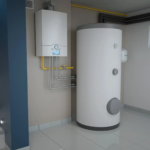
If you have a hot water cylinder in an airing cupboard but no tank of water in the attic, you have a system boiler.
Here are some advantages to keep in mind when comparing system boilers to other types:
Advantages of system boilers
-
Easy installation:
Installing a system boiler is usually a smoother process compared to a regular boiler due to many of the components being built into a system boiler. -
Large hot water storage capacity:
Good for larger or busier homes due to being able to store hot water in a cylinder. -
Fast and economical:
Due to the inclusion of a pump. -
Environmentally-friendly options:
Possible to use solar energy to heat the water.
Disadvantages of system boilers
-
Not ideal for smaller houses:
Unlike a combi boiler, system boilers don’t provide instant hot water and the amount it can provide is limited to the size of the hot water storage cylinder.
The majority of the components required for generating heating and hot water are built into a system boiler. The only external part required is an unvented cylinder that stores the hot water.
By taking their water supply directly from the mains, system boilers eliminate the need for a tank of water in the loft (which would be needed with a regular boiler). They then heat the water to warm up the central heating as well as hot water for the cylinder.